

Zeabur Security Incident: Privileged Access and Secret Rotation
Zeabur's October 2026 security incident illustrates how leaked administrative credentials can connect infrastructure compromise to customer-data exposure. Its preliminary report describes unauthorized access on October 14–15 to shared clusters, GCP Dedicated Servers, and internal systems, followed by reads from its platform database.
The access-control lesson is specific: replacing an application password does not close every path held by a cluster administrator, cloud identity, or backup reader. Recovery requires finding the authority behind those paths and removing it.
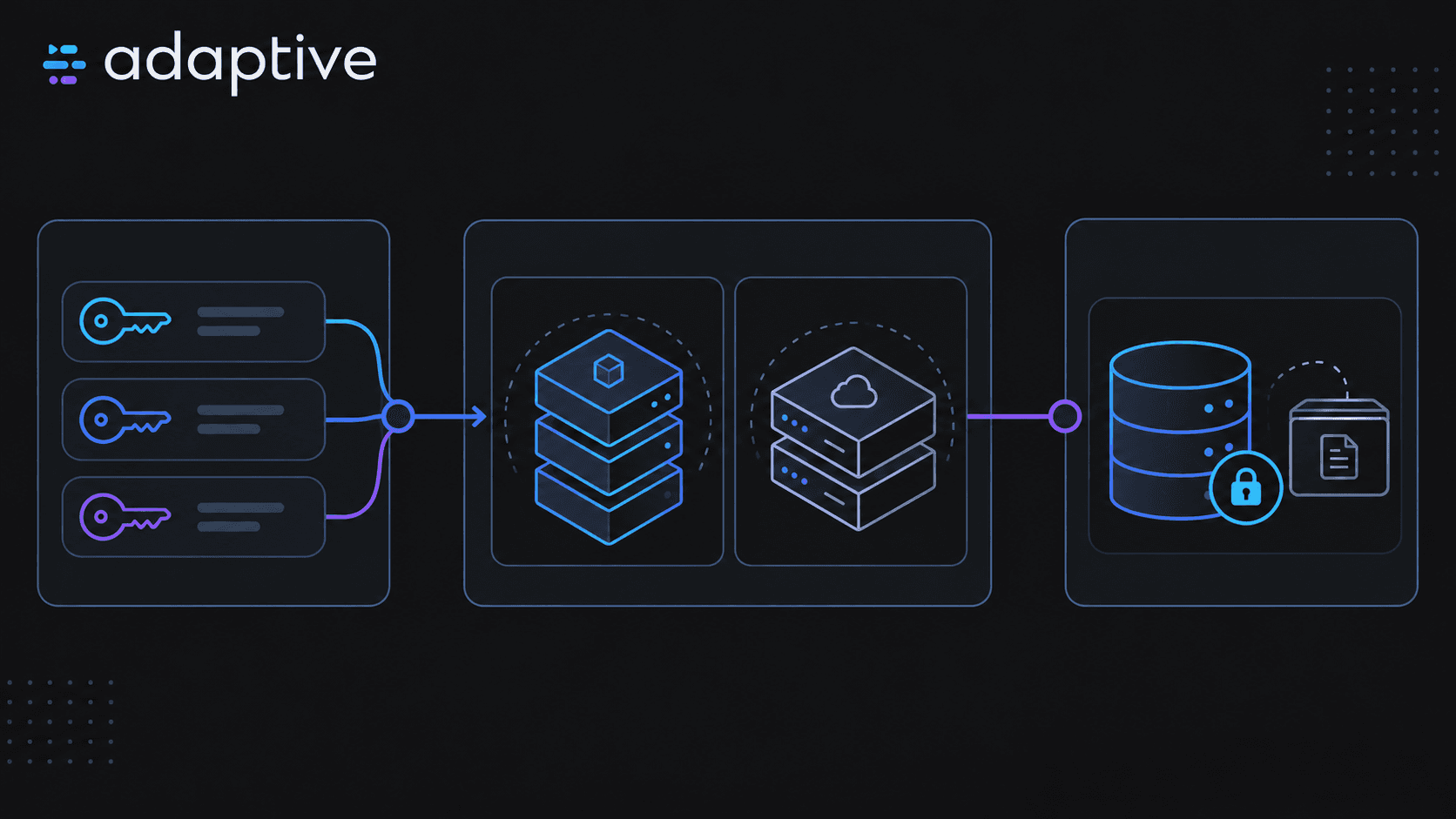
Adaptive can help teams govern supported administrative and workload access through scoped identities, expiring privileges, managed credentials, and attributable records. Its value depends on controlling the actual paths into the infrastructure, including alternatives that could bypass the intended policy.
Published October 28, 2026. This article separates Zeabur's reported findings from Adaptive's architectural recommendations. The provider's investigation remains preliminary.
What did Zeabur confirm?
The incident report identifies non-expiring cluster tokens, plaintext internal credentials, and publicly reachable administration interfaces. It confirms reads of 3,218,965 environment-variable records and account data covering 321,810 accounts. It also records root sign-ins to 101 GCP servers.
A newly rotated credential entered a backup and was later used without authorization; the attacker's retrieval of that backup is assessed rather than directly confirmed. The original credential leak, including a possible connection to August's GitHub App key exposure, remains unconfirmed.
These distinctions matter. A confirmed database read, an assessed acquisition route, and an unverified theory about initial access carry different evidentiary weight. They should not be compressed into a single definitive attack narrative.
Why can changing a database password be insufficient?
A database password controls one authentication path. A person or process with permission to run commands inside the database container may have additional ways to reach its data. A cloud administrator may have authority over the underlying disk. A backup reader may possess an older copy independently of the live service.
Our architectural takeaway is to assess the complete set of access paths to the data, including the infrastructure around it. The application's login is only one part of that assessment.
For example, consider a maintenance workflow that should inspect a single service. If its identity can also execute arbitrary commands across the cluster, read every secret, attach disks, and download backups, reducing the database role leaves substantial authority in place. That example is a design review scenario, not a claim about every affected Zeabur service.
Why does credential rotation need a complete inventory?
Rotation is effective when the old credential is rejected and the replacement cannot be obtained through the same exposure path. A team also needs to know which credentials can create, retrieve, or replace other credentials.
Include configuration repositories, build settings, backup access, server initialization data, emergency accounts, and service identities in the inventory. For each item, record the issuing system, owner, scope, expiry, consumers, and procedure for verifying revocation.
Keep backup authorization separate from live administrative access. A backup containing secrets is part of the secret-management boundary, even when it is kept for recovery. OWASP's secrets-management guidance recommends maintaining lifecycle records, limiting access, and making revocation and rotation repeatable.
This leads to a practical completion criterion: rotation is not finished when a new value has been written. It is finished when the previous authority is invalid, legitimate consumers work with the replacement, and the exposure path has been addressed.
How can Adaptive help with these access risks?
Replace shared administration with attributable access
Adaptive's privileged access brokers supported infrastructure connections and records sessions. Workload identities give automation an identity distinct from a shared human administrator.
Use separate identities for support, deployment, backup operations, and emergency recovery. A support engineer diagnosing one service should not inherit the credentials used to administer all clusters. A backup process should not use the deployment pipeline's cloud identity.
Brokered access reduces the need to distribute reusable downstream passwords. It still requires protecting broker authentication and ensuring that a compromised client receives only the permissions intended for that identity.
Make privileged grants narrow and temporary
Adaptive's authorization controls support granular privileges, approvals, and expiring grants. Apply them to specific maintenance tasks and resources instead of issuing permanent administrative access for occasional work.
| Task | Access to define | Separate authority to withhold |
|---|---|---|
| Inspect a service failure | Approved diagnostic commands for the selected service | Cluster-wide secret retrieval and unrelated container execution |
| Maintain a database | Required operations on the selected database during an approved window | Cloud disk administration and backup export |
| Restore a backup | Access to the selected recovery material and destination | Permission to enumerate unrelated backups or alter retention policy |
| Run a deployment | The intended repository, artifact, and target environment | Administration of workload identities and access policies |
This table is an example policy design. Available enforcement depends on the connector, protocol, and destination permissions. Test the actual operation, including subprocesses and alternate interfaces, before treating a policy label as an effective boundary.
Reduce direct routes around governed access
Adaptive's private resource access can help teams expose selected resources to authorized identities. Pair it with destination firewall rules, cloud IAM, and cluster authorization so administrative interfaces do not remain reachable through unrestricted alternatives.
Network membership alone should not grant database or cluster privileges. A newly connected machine still needs an explicitly scoped identity. A permitted database connection should also have an appropriate database role.
These layers address different questions: whether a resource can be reached, whether the caller can authenticate, and whether the requested operation is allowed.
Manage supported credential lifecycles centrally
Adaptive's credential rotation provides rotation for supported database, server, and network-device passwords. Centralizing these credentials can make ownership, replacement, and revocation easier to operate consistently.
Cloud service-account keys, cluster tokens, application signing keys, and external API keys need their own supported lifecycle mechanisms. Do not assume a database-password rotation feature covers every credential in an incident. Coordinate issuer revocation with infrastructure recovery and verify the old credentials fail.
Keep evidence tied to identities and resources
Adaptive's audit capabilities record supported queries, commands, and sessions against their identities. SIEM integration lets teams correlate those events with cloud, cluster, network, and database logs.
For the example policies above, useful review signals include access outside the approved resource set, unusual secret reads, administrative grants, and unexpected backup operations. Configure these detections using the systems that observe the underlying activity. Adaptive cannot record traffic that bypasses its access path.
Store exported evidence under separate administrative control, and test that the workload under investigation cannot delete it. A missing event should prompt a visibility check, not an automatic conclusion that nothing happened.
What should affected Zeabur users do?
Follow Zeabur's remediation instructions for your deployment type. They call for replacing affected credentials, checking provider activity, and rebuilding compromised GCP hosts. Zeabur warns that earlier rotation after August does not remove the need to respond to this incident.
Separate three workstreams in your own response: contain unauthorized access, recover trusted infrastructure, and investigate what the exposed authority was used to do. Changing a password does not remove an installed persistence mechanism or recover data that has already left a system.
Introducing an access broker is a follow-on control improvement. It does not substitute for the provider's incident-specific remediation or establish that a host is clean.
Frequently asked questions
Q: Was Zeabur's October incident conclusively traced to the August GitHub App key leak?
No. Zeabur identifies that connection as a hypothesis, not a confirmed initial-access path. Refer to the distinctions in its preliminary report.
Q: Does rotating an application password remove cluster-level access?
No. Cluster, cloud, host, and backup permissions are separate authorities. Review and revoke the affected administrative identities as well as the application's credentials.
Q: How can Adaptive reduce the impact of stolen credentials?
For supported access paths, Adaptive can keep downstream credentials behind a broker, restrict an identity's resource permissions, require temporary approvals, rotate supported passwords, and record activity. Direct paths and alternate credentials must be controlled too.
Q: Can Adaptive protect a database after its host is already compromised?
An access broker does not remove an attacker's local host privileges. Contain and recover the host first, then enforce and validate the intended network, identity, and resource boundaries.
Review privileged access with Adaptive
Start with one production service and list every identity that can reach its database, container, host, secrets, and backups. Request an Adaptive demo to review which access paths can be brokered and how to make each privileged operation scoped, temporary, and attributable.
Download this article as Markdown or plain text for LLMs. Both include publication metadata and source links.
- preliminary report — https://zeabur.com/blogs/october-2026-security-incident
- OWASP's secrets-management guidance — https://cheatsheetseries.owasp.org/cheatsheets/Secrets_Management_Cheat_Sheet.html




 |
 SOC2 Type II

