

Railway Security Incident: Credential Exposure and Access Controls
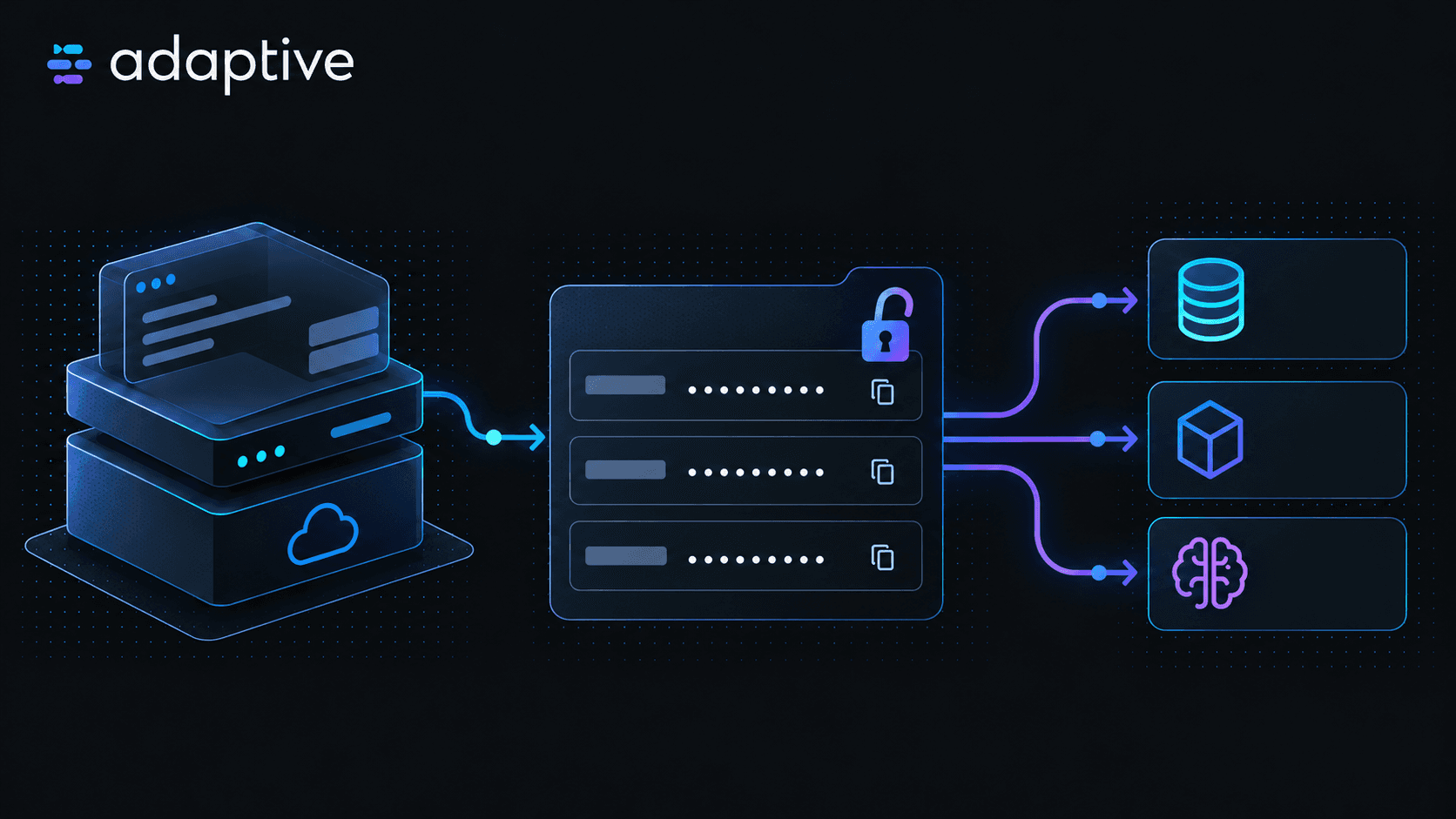
Railway's October 2026 security incident involved unauthorized access to internal systems and possible exposure of customer secrets. Its October 21 disclosure warned that encrypted environment variables, and some decrypted values, may have been accessed. Railway advised customers to rotate stored secrets, including API keys and private registry credentials, and inspect service logs.
For teams using a deployment platform, the access question extends to every system those credentials can reach. A database password, registry token, or AI provider key carries authority outside the platform that stores it.
Adaptive can help reduce that exposure for supported connections by brokering credentials, restricting workload permissions, and recording access. Those controls require deliberate integration and enforcement; they do not establish that Adaptive would have prevented Railway's internal compromise.
Published October 28, 2026. Incident facts below reflect Railway's public reports reviewed on that date; the architectural recommendations are Adaptive's analysis.
What happened in the Railway security incident?
Railway's October 22 preliminary report, subsequently updated, describes escalation across internal systems, access to CI credentials, and decryption of a subset of customer environment variables. It estimates potential exposure in at most 1.85% of workspaces, approximately 100,000. Broader precautionary key revocations do not prove that every notified customer's secrets were accessed.
Railway says running customer applications stayed online while new builds were paused. Its October 26 update reports service restoration for existing users. The report does not disclose the complete initial exploit, so claims about a specific unpatched vulnerability or a proven attacker attribution would go beyond the published evidence.
The practical distinction is between platform availability and credential validity. An application can continue serving traffic while a credential it uses needs revocation at another provider.
Why does an environment-variable exposure create downstream risk?
Environment variables are a convenient configuration interface. When they contain reusable secrets, access to that configuration can become access to a database, cloud account, code repository, or paid API.
Encryption at rest protects stored values under a particular key and access model. The application still needs a way to use those values. If the same compromise reaches both ciphertext and an authorized decryption path, storage encryption alone cannot enforce the intended workload boundary. OWASP's secrets-management guidance addresses this distinction and recommends restricted secret access, lifecycle management, and auditing.
For your own application, review three separate permissions: who can retrieve a credential, who can use it, and who can broaden its authority. Combining all three under the deployment identity makes a single exposure harder to contain.
What should affected Railway customers do?
Start with Railway's customer guidance and the issuing providers' revocation procedures. A useful recovery record should answer these questions for every relevant secret:
| Recovery question | Evidence to keep |
|---|---|
| Has the exposed credential been revoked at its issuer? | Credential identifier, revocation time, and a failed authentication check using the old credential |
| Which deployments and jobs used it? | Service owners, environments, scheduled jobs, and deployment versions |
| Are replacement credentials narrowly scoped? | Allowed resources and operations, with separate production and development identities |
| Is the replacement active in the running workload? | Successful connection checks after redeployment, without printing secret values |
| Was the old authority used unexpectedly? | Provider audit events, repository and registry changes, and unusual API usage or billing |
Treat containment as urgent. If replacing a credential requires downtime, choose that tradeoff explicitly rather than silently leaving a suspected credential active. Preserve investigation evidence while removing access.
Railway's deployment recovery guide explains another operational issue: commits submitted during the pause were not queued. Teams may need to reconnect GitHub, recreate revoked CLI or CI credentials, and trigger the intended deployment. Updating a dashboard variable is not evidence that the running application has adopted it.
How can Adaptive help with this scenario?
Keep downstream credentials out of workload configuration
Adaptive's workload access controls give service accounts and pipelines their own identity and broker supported resource connections through centrally managed credentials.
For example, an application that only needs a reporting database should receive access to that resource through a restricted workload identity. Its deployment configuration should not carry the database administrator's reusable password. The broker and its credential store must sit behind a separate administrative boundary from the workload.
This changes the consequence of a configuration leak: an exposed workload token should authorize only its configured scope. It is still a credential and still needs revocation if compromised. A broker does not make a compromised application harmless.
Separate routine access from privileged maintenance
Adaptive's authorization workflows support resource permissions, approval routing, and grants that expire. Use them to separate an application's normal data access from migrations, production debugging, and administrative changes.
A reporting worker might read approved tables continuously. A migration identity might receive write access for a short, approved maintenance window. Neither needs permission to change the other identity's policy or retrieve unrelated secrets.
Enforce these restrictions at the destination as well. If the workload can connect directly using a second credential, that path can bypass the broker's policy.
Make rotation a maintained operating capability
Adaptive's credential rotation supports password rotation for connected databases, servers, and network devices. Central management can reduce the number of places an operator must update when a supported credential changes.
Provider-issued AI keys, registry tokens, and third-party API credentials still require the corresponding provider's supported revocation and replacement process. Validate integration coverage before including a credential type in an automated rotation plan. Keep issuer identifiers and ownership records so an incident does not begin with a search for who controls each key.
Preserve attributable evidence outside the workload
Adaptive's audit capabilities associate supported operations with identities. SIEM streaming sends access events to the team's monitoring tools for correlation.
Combine these records with deployment, cloud, database, registry, and AI-provider logs. Investigators need to connect an identity to its permitted resources, the operations attempted, and the time its access ended. Keep the exported evidence under credentials the workload cannot use to delete it.
For AI agents that operate infrastructure, governed MCP access applies authorization and records tool activity on supported endpoints. This governs agent tool access; it does not automatically proxy every model-provider request made by an application.
How should a team validate the access boundary?
Use a staging workload with the permissions you intend to grant in production. Confirm that its ordinary task succeeds, then test the limits:
- Attempt access to a second database or environment. It should be denied.
- Attempt an administrative operation outside the workload's role. It should be denied even when the identity can authenticate.
- Revoke the workload's grant and check both new connections and existing sessions according to the connector's behavior.
- Verify that the workload cannot retrieve the downstream password or erase exported activity records.
- Check that direct network paths and alternate credentials do not bypass the intended policy.
These checks give a concrete measure of exposure. A successful broker login alone does not show that the workload has appropriately narrow authority.
Frequently asked questions
Q: Were all Railway customers' secrets confirmed stolen?
No. Railway reported potential exposure affecting a subset of workspaces and requested broader precautionary revocations. A revocation notice alone is not confirmation of theft. See its preliminary report.
Q: Does changing an environment variable revoke the old API key?
No. Replacing the configured value and revoking the old credential at its issuer are separate actions. Confirm the old key is rejected and the running workload uses the replacement.
Q: Can Adaptive prevent a deployment provider from being compromised?
Adaptive governs supported access paths you configure through it. It can help limit downstream credential exposure and permissions, but cannot guarantee prevention of a separate provider's internal compromise or remove an attacker's existing access there.
Q: Does Adaptive automatically rotate every AI-provider or registry key?
No such universal coverage is implied. Use Adaptive's supported credential-rotation integrations where available and the issuing provider's procedures for other keys. Test the complete recovery workflow before relying on it.
Review your workload access with Adaptive
Choose one production workload and map its identities, stored secrets, reachable resources, and emergency revocation steps. Request an Adaptive demo to evaluate which connections can be brokered, which privileges can be reduced, and which activity records your team needs.
Download this article as Markdown or plain text for LLMs. Both include publication metadata and source links.
- October 21 disclosure — https://blog.railway.com/p/security-disclosure-wednesday-october-21st
- October 22 preliminary report — https://blog.railway.com/p/preliminary-report-october-security-incident
- OWASP's secrets-management guidance — https://cheatsheetseries.owasp.org/cheatsheets/Secrets_Management_Cheat_Sheet.html
- deployment recovery guide — https://blog.railway.com/p/security-disclosure-recommendation-recover-failing-deploys




 |
 SOC2 Type II

