

The LiteLLM Breach and How to Secure Agent Access
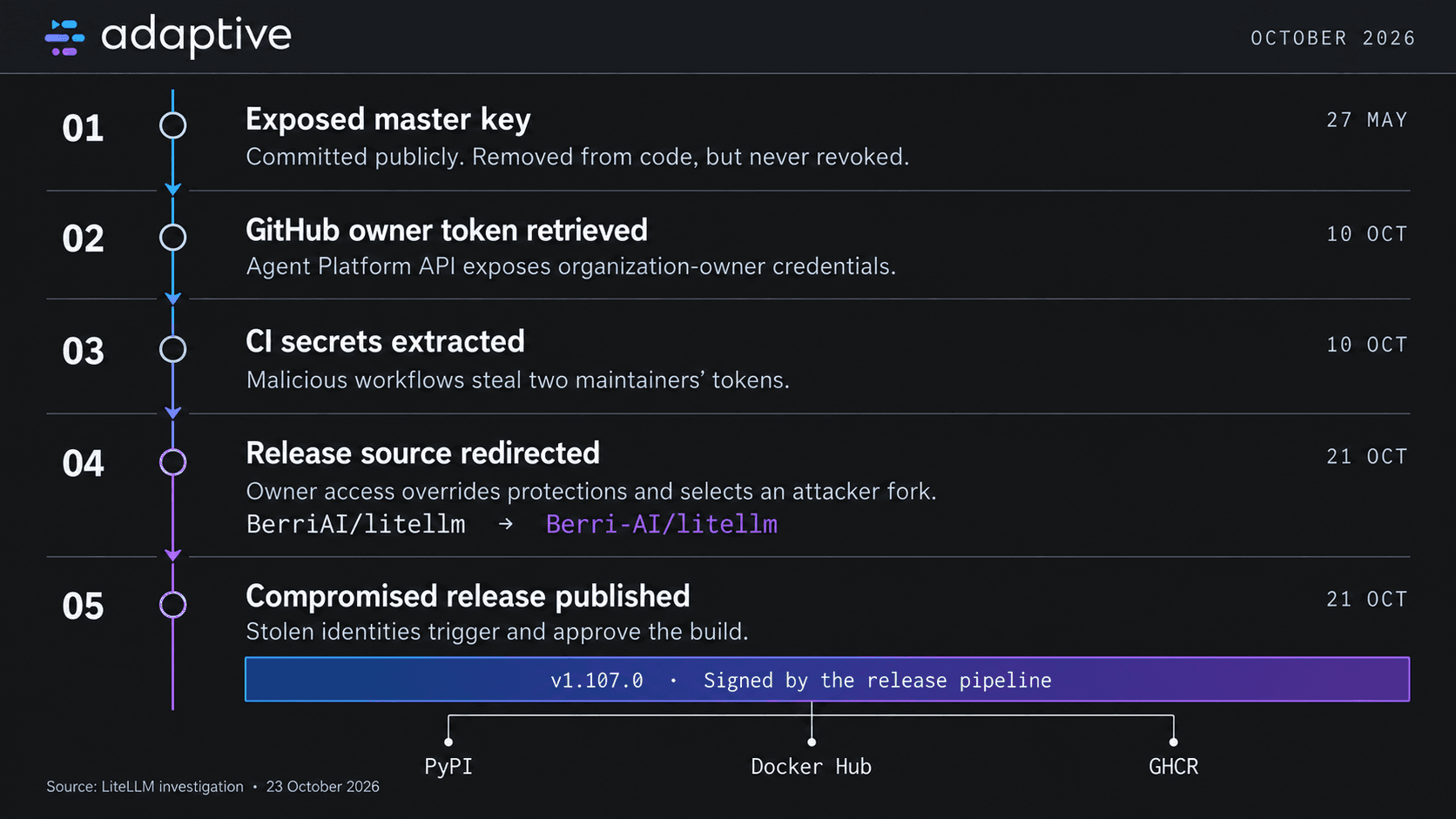
The October 2026 LiteLLM breach compromised release v1.107.0 through stolen credentials and release-pipeline access. The affected artifacts reached PyPI and container registries and contained credential-stealing malware. LiteLLM says its private enterprise distribution was unaffected. See its incident advisory for affected artifacts and response instructions, and its October 23 investigation for the corrected attack sequence.
For teams building with AI agents, the incident raises a practical access question: how much authority should an agent platform hold, and what happens if someone gains access to it?
Adaptive addresses that question by placing identity, authorization, credential handling, and audit controls between agents and the systems they use. The useful design goal is specific: a coding task should have access to its approved repositories and tools, without carrying administrative authority over the release process.
Reviewed October 28, 2026 against LiteLLM's incident advisory and completed investigation. The access-control recommendations below are Adaptive's analysis.
How did the LiteLLM breach happen?
LiteLLM's October 23 investigation supersedes its early explanation about credentials leaking through logs. It describes this sequence:
- An exposed key remained valid. A master key committed publicly on May 27 was removed from the repository but never revoked.
- Platform access revealed a privileged token. On October 10, the attacker used that key to query the Agent Platform API and retrieve an organization owner's GitHub CLI token.
- CI became a way to collect more credentials. Malicious workflows extracted additional secrets, including two maintainers' tokens.
- Release protections were overridden. The owner token bypassed repository protections and redirected the release workflow to an attacker-controlled repository.
- Stolen identities completed the release. The attacker triggered and approved the build using compromised accounts. The pipeline signed the artifacts; workflow records were subsequently deleted.
The architectural lesson is that access to one service should not expose credentials powerful enough to administer unrelated systems. Removing a secret from a file also leaves the credential valid until the issuing system revokes it.
Why did existing security controls fall short?
Authentication establishes which credentials a request presents. Authorization determines what those credentials permit. When a workflow carries an administrator's token, an attacker who obtains that token can inherit authority far beyond the workflow's intended job.
Approval processes need the same scrutiny. Two accounts provide limited separation if the same environment exposes both accounts' credentials. Protecting an approval requires separating the approver's access from the workload requesting the change.
Artifact signing addresses another boundary. A valid signature cannot establish that the source was appropriate when the authorized pipeline itself built malicious input. Our takeaway from the documented release sequence is that release integrity depends on protecting source selection, workflow changes, and publishing authority together.
How can Adaptive address these access risks?
Adaptive provides controls for the agent's identity, execution environment, resource access, and activity records. Apply them to the operations routed through Adaptive, and remove direct credentials and alternate routes that would bypass those controls. GitHub permissions and CI configuration must enforce the same boundaries at the destination.
Keep infrastructure credentials outside the agent runtime
An agent that needs to run a query or call a tool does not need to read the credential used to authenticate that operation. Adaptive's governed MCP access brokers supported resource connections and applies the invoking user's authorization, without requiring downstream credentials in the agent's configuration.
That changes what a compromised agent can collect. The agent can request a permitted operation through the broker; its configuration should not contain a reusable credential for unrestricted direct access.
Broker authentication still needs protection. The broker and its credential store remain privileged infrastructure, with their own administrative boundaries. An agent must not be allowed to retrieve their secrets through another tool or configuration endpoint.
Give the agent a role specific to its task
For a coding task, define the repository, allowed operations, and access duration before execution. A workflow that proposes a change should not also administer the organization, edit release protections, or approve its own deployment.
Adaptive's coding-agent controls support scoped repository access and policies for the commands and network endpoints available to a session. Use those controls alongside narrowly scoped destination credentials. The authorization needs to hold even if the agent produces an unexpected command.
Delegating a user's access also requires care: if that user has broad privileges, inheritance alone is too permissive for a narrow task. Choose a restricted role or identity for the workflow.
Limit elevated access by time and approval
Adaptive's authorization workflows support granular permissions, approval routing, and grants that expire. A production operation can require a separate access request with a defined purpose and duration.
Keep release approval credentials outside the coding environment. Routine code changes should not require temporary organization-owner access. If exceptional administration is necessary, use a separate administrative workflow and review its activity.
Expiry reduces the time available for misuse. It does not make a powerful permission safe while active. Test how revocation affects both new requests and already established sessions for each connected system.
Enforce restrictions while the agent runs
Exo, Adaptive's agent harness, combines isolated execution environments with authorization for agents and tool calls. The coding-agent environment also supports command restrictions and network allowlists.
For a repository task, configure access to approved source repositories and required build services. Restrict arbitrary outbound destinations, unrelated production systems, and administrative tools. Check scripts, subprocesses, and alternate clients when validating those boundaries; a command-name rule alone is not a complete isolation mechanism.
A sandbox should start with limited credentials and limited reachability. Destroying it after execution does not reverse data already sent elsewhere or changes already made to a remote system.
Preserve evidence outside the execution environment
Adaptive's audit capabilities associate supported activity with identities and provide session records and SIEM streaming. Combine those records with GitHub, CI, registry, and cloud audit events to reconstruct a release across systems.
Store the exported evidence under separate administrative control. An identity allowed to run a workload should not also be able to erase the security team's records. Configure alerts for changes to access policy, unexpected privilege grants, and missing audit ingestion.
Recording an operation helps investigation. Blocking it requires an enforcement policy at the relevant access or execution boundary.
What would a scoped coding-agent workflow look like?
Consider an agent asked to fix a bug and open a pull request. The following is an example access design, rather than a description of LiteLLM's deployment:
| Boundary | Access to configure |
|---|---|
| Identity | A dedicated task identity or restricted delegated role, attributable to its requester |
| Repository | The selected repository and the operations needed to propose a change |
| Credentials | Brokered tools where supported; no organization-owner token in the agent environment |
| Execution | An isolated session with approved commands and network destinations |
| Duration | A grant bounded by the task, with a tested revocation path |
| Release | A separate workflow, publishing identity, and independent approval |
| Evidence | Activity exported to storage the task identity cannot modify |
Before enabling the workflow, test whether it can reach a second repository, change access controls, contact an unapproved destination, or invoke release operations. Those requests should fail under the configured policies. Also verify that the permitted task still succeeds and that its activity can be reconstructed.
This gives the team a concrete acceptance criterion: the agent can complete its assigned work within a defined set of permissions.
What still needs protection in the release pipeline?
Agent access controls are one part of software supply chain security. Separately protect the repository rules, workflow definitions, build inputs, signing authority, and registry permissions used to produce and distribute software.
Review who can override protections. Keep publishing credentials out of ordinary test jobs. Verify the expected source repository and revision before promotion, and limit who can change those checks. Export release evidence to a separately controlled destination.
For an environment that ran an affected LiteLLM artifact, follow the maintainer's incident response instructions. Rebuilding affected environments and revoking exposed credentials are response actions; deploying new access controls does not clean up an existing compromise.
Frequently asked questions
Q: What caused the October 2026 LiteLLM breach?
An unrevoked Agent Platform key exposed an organization-owner token, enabling further credential theft and release compromise, according to LiteLLM's investigation.
Q: How does Adaptive help secure AI agent access?
Adaptive combines scoped permissions, brokered resource access, time-bound grants, and identity-linked audit records. Exo adds isolated agent execution and tool-call policies. Their effectiveness depends on routing the relevant operations through those controls and removing bypass access.
Q: Does putting an agent in a sandbox protect its credentials?
A sandbox limits execution boundaries, but secrets placed inside it may still be accessible to its processes. Keep downstream credentials outside the agent runtime where supported, restrict outbound access, and limit the permissions of every credential the session can use.
Q: Can Adaptive replace GitHub and CI security controls?
Adaptive governs connected access and agent execution. Repository protections, CI isolation, source verification, signing, and registry permissions still require their own configuration. The access layer and destination permissions should enforce a consistent scope.
Q: What should a team evaluate first?
Choose one agent workflow and document its identities, credentials, reachable resources, and allowed operations. Then test whether its configured permissions permit anything beyond the task, whether revocation stops access, and whether independent records capture the activity.
Apply this to your agent workflows
Start with the tasks your agents perform today and remove authority they do not need. Use Adaptive to broker supported access, restrict execution, and maintain an attributable record, while keeping release administration separately controlled.
Request an Adaptive demo to review a real workflow, the integrations it uses, and the policies needed to enforce its access boundaries.
Download this article as Markdown or plain text for LLMs. Both include publication metadata and source links.
- incident advisory — https://docs.litellm.ai/blog/security-incident-oct-21-2026
- October 23 investigation — https://docs.litellm.ai/blog/security-incident-oct-21-2026-attack-chain




 |
 SOC2 Type II

