

Which AMD KVM hosts need the CVE-2026-99312 patch?
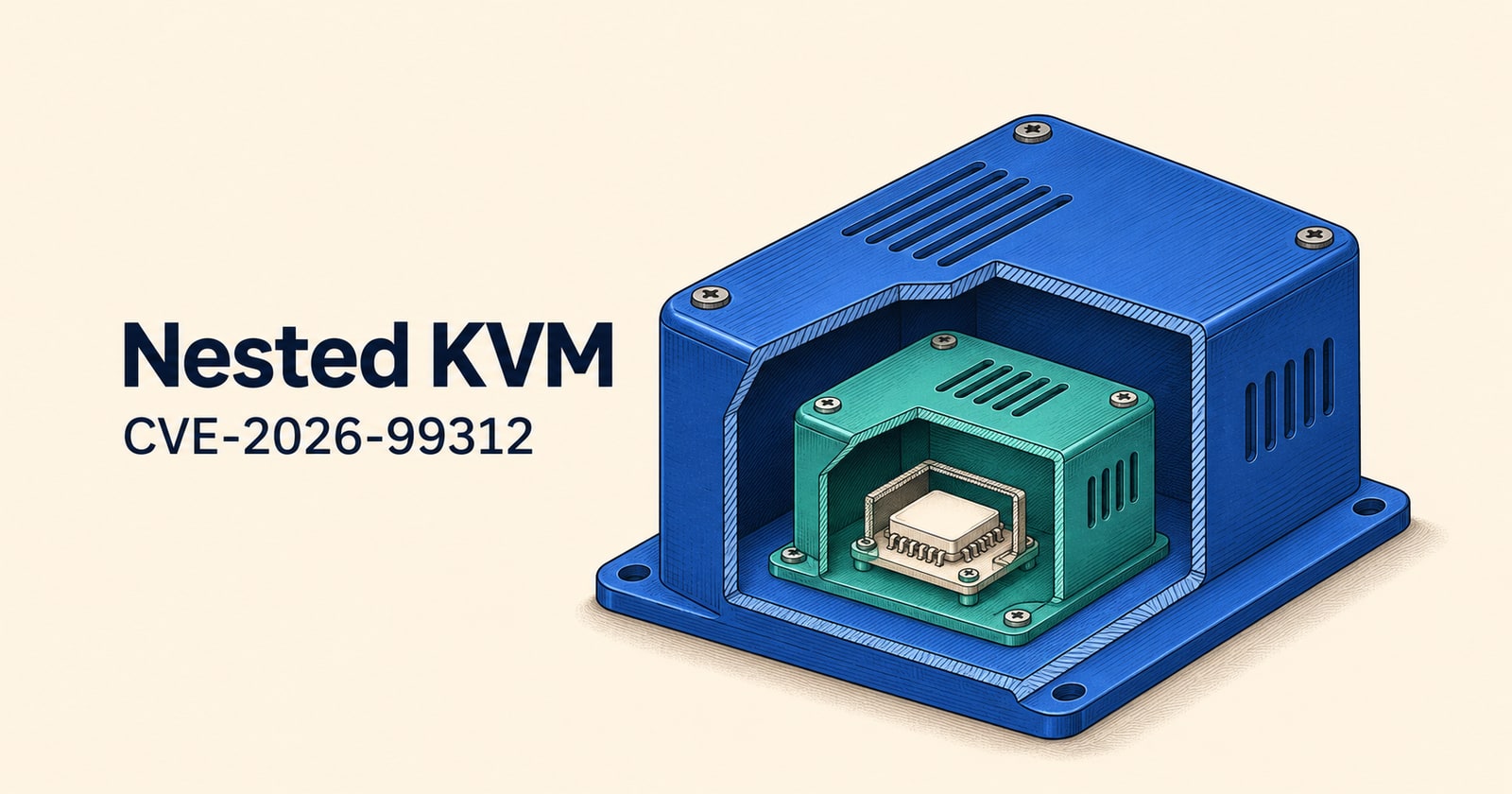
A continuous integration (CI) runner can report a freshly updated kernel while the physical server beneath it still needs a patch. CVE-2026-99312 affects Linux’s Kernel-based Virtual Machine (KVM) on AMD systems running nested virtual machines. If your runner boots VMs of its own, verify the fix on the physical server that hosts it. Linux kernel CVE record
What goes wrong between the two guests?
Take a team that tests a Linux installer. A physical AMD server runs KVM (level 0, or L0). One of its VMs is the CI runner (L1). For each test, the runner boots the installer in a disposable VM (L2). Each guest has its own view of memory, and KVM tracks how to translate addresses for whichever guest is running. Linux guide to nested KVM
On an affected host, KVM can resume the runner after a virtual CPU initialization event (INIT) with the test VM’s memory-translation state still in use. The patch makes KVM reset its memory management unit (MMU) context every time it emulates that event. The maintainers narrowed the flaw to AMD’s nested Secure Virtual Machine (SVM) implementation. Intel’s VMX intercepts the event before it can reach this path. Upstream KVM fix
How to check and patch a KVM host
- Identify hosts that offer nesting. On the physical AMD host, run
uname -rand read/sys/module/kvm_amd/parameters/nested. A value of1orYmeans nesting is enabled. Check which runner VMs can use the virtualization extension. Pools that never run nested guests can keep nesting disabled. If a cloud provider operates the physical host, ask it to confirm the patch status for that pool. Linux nested KVM configuration - Match the kernel to its release line. The upstream record lists fixes in 6.12.118, 6.18.64, and 7.3.5 on their respective stable branches, and 7.4-rc2 in mainline. For a distribution kernel, use the vendor’s full package revision to account for backports. For example, Debian lists
7.3.5-1as fixed in unstable and tracks its other releases separately. Upstream version record · Debian package status - Drain the host and verify it after reboot. Pause new jobs and let the nested test VMs shut down before moving a runner. Linux documents unpredictable behavior if you live-migrate an AMD L1 guest while L2 is active. Install the fixed host kernel, reboot the physical server, and compare its running kernel release and package build with the vendor’s fix before returning it to the pool. Linux guidance on nested guest migration
How Adaptive can secure the CI fleet during patching
A guest can reach the affected KVM code even when SSH to the host is locked down. The kernel update corrects the memory handling. Adaptive lets the virtualization team decide who can inspect those hosts, change their configuration, and install the patch.
- Keep host credentials out of build jobs. If the pipeline needs a staging database, give it an Adaptive workload identity scoped to that database. Broker host SSH through a separate endpoint restricted to the virtualization team, and revoke any host keys previously copied into CI. A leaked job credential then has no grant to sign in to the hypervisor. Adaptive workload identities · Adaptive SSH integration
- Let responders check exposure without opening a shell. Give responders a script-only SSH endpoint backed by an unprivileged host account. Have an administrator save a script that reports the hostname, running kernel build, and nesting setting. Disable script creation for accessors so responders can run the approved check on their assigned hosts without gaining patch privileges. Script-only endpoints · Accessor script permissions
- Grant a patch window for the affected hosts. On the maintenance endpoint, require single sign-on, MFA, and just-in-time approval. For example, an on-call engineer can request one hour on the hosts scheduled for tonight’s rollout. Adaptive brokers SSH using the host credential and expires the grant when the window closes. Adaptive infrastructure access · Just-in-time endpoint configuration
- Keep evidence for each reboot. With terminal recording enabled, the reviewer can see who opened the maintenance session, which host they reached, and which kernel they installed. Pair that session with a fresh inventory script result from the same host after reboot. Together they show both the change and the kernel that actually came back into service. Adaptive session logs and recordings
- Linux kernel CVE record — https://www.cve.org/CVERecord?id=CVE-2026-99312
- Linux guide to nested KVM — https://docs.kernel.org/virt/kvm/x86/running-nested-guests.html
- Upstream KVM fix — https://git.kernel.org/linus/c7c288d178cb0b78d3464a616b16b1aa0b316049
- Linux nested KVM configuration — https://docs.kernel.org/virt/kvm/x86/running-nested-guests.html#enabling-nested-x86
- Upstream version record — https://github.com/CVEProject/cvelistV5/blob/main/cves/2026/99xxx/CVE-2026-99312.json
- Debian package status — https://security-tracker.debian.org/tracker/CVE-2026-99312
- Linux guidance on nested guest migration — https://docs.kernel.org/virt/kvm/x86/running-nested-guests.html#live-migration-with-nested-kvm
- Adaptive SSH integration — https://documentation.adaptive.live/integrations/ssh
- Script-only endpoints — https://documentation.adaptive.live/v1.1.x/platform/access-management/scripts
- Accessor script permissions — https://documentation.adaptive.live/v1.1.x/platform/organization/workspace-settings
- Just-in-time endpoint configuration — https://documentation.adaptive.live/v1.1.x/platform/access-management/jit-endpoint
- Adaptive session logs and recordings — https://documentation.adaptive.live/v1.1.x/platform/access-management/sessions




 |
 SOC2 Type II

