

Binance Hack: From DevOps Access to Wallet Control
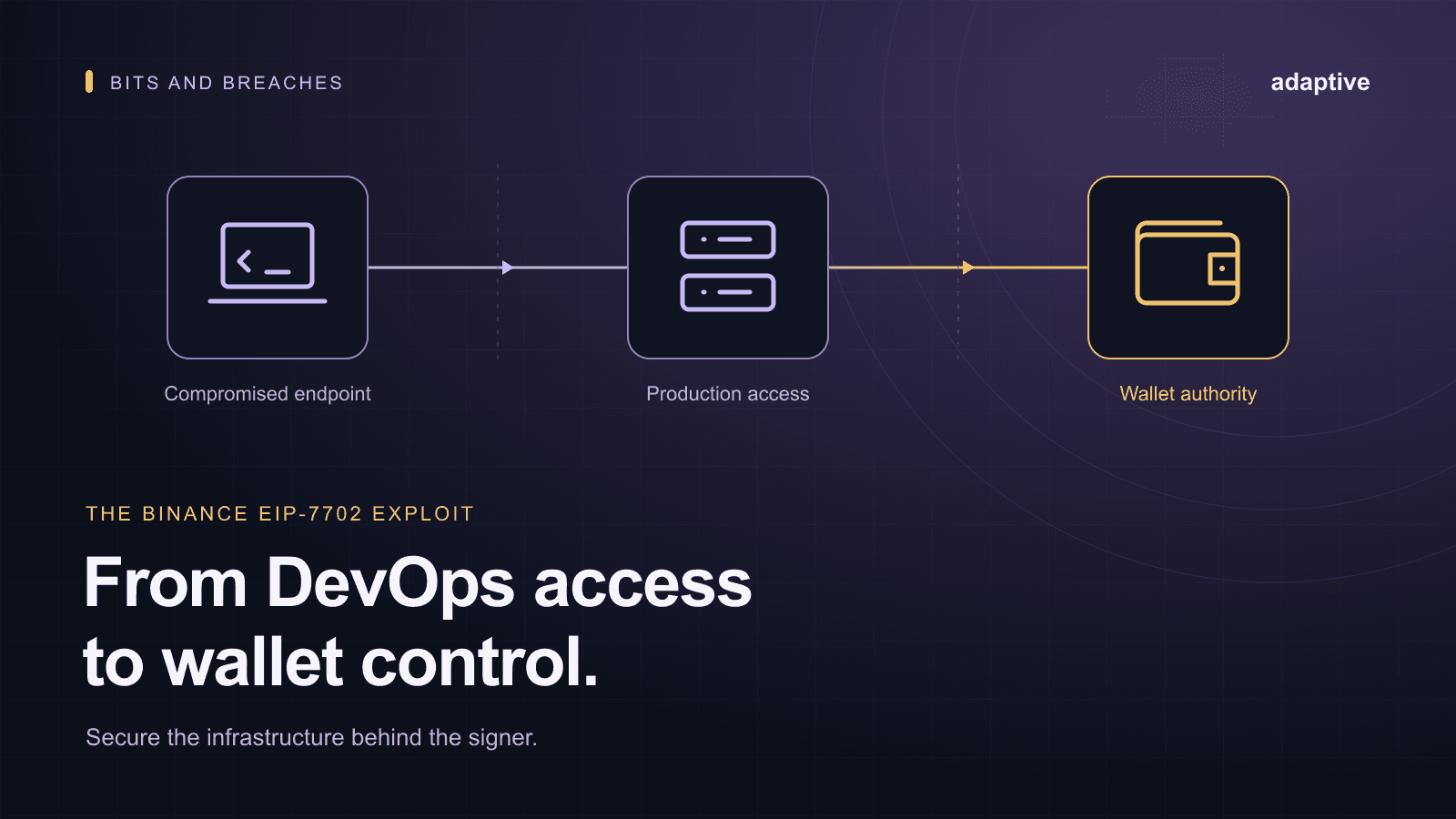
An attacker does not have to steal a private key if they can make the system holding it sign a malicious request. That is the access-security problem at the center of Fireblocks' analysis of the Binance exploit.
In its October 30, 2026 update, Binance reported approximately $6.3 billion in assets stolen from hot wallets on October 29. It said its initial investigation suggested a compromised laptop, that investigators had found additional compromise points, and that it had found no evidence of leaked wallet private keys.
For engineering and security teams, the question is concrete: what can someone controlling an engineer's machine persuade production systems to do? Adaptive can help constrain that access through brokered connections, temporary privileges, separate workload identities, and activity records.
Published November 2, 2026. The incident account below draws on the October 30 Binance update and Fireblocks analysis. Those disclosures do not establish the complete intrusion path. The proposed access design is Adaptive's analysis.
How did the reported compromise reach the wallets?
Fireblocks describes this sequence:
- A DevOps workstation was compromised. The attacker reportedly reached a service container through a machine with deployment access and signing capabilities.
- Wallet authority was redirected. A signed EIP-7702 authorization delegated the Binance 14 hot wallet to a malicious contract. The attack established a new delegation rather than exploiting an existing delegation contract.
- The attacker invoked the delegated wallet. The malicious code executed in the wallet's context and transferred assets out. Fireblocks reports the first transfers within three minutes of delegation.
- The delegated authority remained useful. Subsequent calls could drain additional funds, including new deposits, without a fresh wallet signature for each transfer.
This describes the reported EIP-7702 component. It does not explain every affected chain: Fireblocks explicitly separates Bitcoin and Tron movements from that mechanism. The disclosures also leave open how the laptop was first compromised and the full extent of access to the signing infrastructure.
What made EIP-7702 delegation powerful?
EIP-7702 lets an externally owned account, normally controlled by a private key, authorize execution of another contract's code in its own context. The account signs an authorization identifying the delegate, chain scope, and nonce; another party can submit it.
The delegation persists until changed or cleared. It is not limited to the transaction that installs it. A malicious delegate can therefore permit later asset transfers without requiring the account owner to approve each one.
The security decision is the delegation itself: which code is this account authorizing to act for it? Reviewing ordinary transfers alone leaves that decision outside the review. The standard's security considerations emphasize the substantial authority granted to delegated code.
Why protecting the key is only part of the design
Consider a hypothetical withdrawal service. Its key stays inside a dedicated signing system. An engineer cannot export it, but can change the service that prepares signing requests. If the signer accepts whatever that service submits, the engineer's deployment permission indirectly controls what gets signed.
That is a design review scenario, not a claim about Binance's exact implementation. It illustrates why access reviews need to follow permissions through several systems:
| Permission to review | Question it should answer |
|---|---|
| Inspect a production service | Can the operator also execute code inside it or read its secrets? |
| Deploy an application | Can the deployer change the component that constructs signing requests? |
| Use a workload identity | Does that identity permit ordinary operations, policy changes, or both? |
| Administer the signer | Can the same person change policy and approve the resulting request? |
| Manage access controls | Can an operator grant themselves a more powerful role? |
A login approval answers who may enter a system. A separate signing decision must assess the operation that system requests. Both boundaries need their own enforcement and evidence.
How Adaptive can help secure the infrastructure behind the signer
Give engineers access to a task, with an expiry
Adaptive's authorization controls support granular roles, approval workflows, and expiring grants. Use them to define what an on-call engineer needs for a particular investigation: the resource, permitted operations, approver, and access window.
For example, diagnosing a withdrawal queue might require logs and selected database reads for 30 minutes. It need not include a shell on the signing host, production secret access, or permission to deploy a replacement service. Escalation to maintenance should be a separate reviewed grant.
Scope matters as much as duration. A temporary administrator can still do serious damage during an approved session. Validate restrictions against the actual commands, resource roles, and integration in use.
Keep infrastructure credentials behind the access broker
Adaptive's privileged access brokers supported connections to servers, databases, Kubernetes, and cloud resources. Engineers authenticate with their own identities while downstream credentials remain behind the broker.
That reduces reusable infrastructure secrets on laptops and makes individual access easier to revoke. A compromised endpoint may still abuse an active, permitted session, so pair credential isolation with narrow permissions and session controls.
Enforce the same access design through destination permissions and network restrictions. Direct SSH, cloud consoles, emergency accounts, and cluster credentials must not provide an unrestricted alternative to the approved connection.
Separate people, deployments, and runtime workloads
Adaptive's workload access supports distinct identities and brokered access for pipelines, services, and agents. Give each production workflow an identity with a specific owner and resource scope.
For a withdrawal platform, separate the engineer investigating a failure, the pipeline deploying an approved artifact, and the running service accessing its database. Manage permission to alter any of those identities separately too.
This makes a useful review possible: can the diagnostic identity become the deployment identity, or can the deployment identity rewrite its own access policy? Enforce the answers through the relevant cloud, cluster, and application controls as well as Adaptive. A signing system still needs to evaluate requests independently of those infrastructure identities.
Make access activity available to responders
Adaptive's audit capabilities capture supported commands, queries, and sessions against identities. SIEM integration brings those records into the tools security teams already use.
Correlate an access approval with the resulting session, a deployment change, a signing request, and an on-chain event. That requires evidence from the access platform, deployment system, signer, and blockchain monitoring; no single log establishes the whole sequence.
Administrators can terminate supported live sessions through Adaptive. During an incident, coordinate that action with endpoint isolation, credential revocation, and wallet-specific containment. Ending an infrastructure session does not reverse an authorization already recorded on-chain.
Where wallet controls must take over
Adaptive governs supported infrastructure access. Wallet custody, transaction validation, and EIP-7702 delegation policy belong in the signing and wallet systems.
For an example architecture, require independent review of delegation changes, restrict general-purpose signing, and test that a service authorized for routine withdrawals cannot change wallet authority. Keep the approval mechanism under administration separate from the workload making the request. These are deployment requirements to verify, not claims of a native Adaptive wallet integration.
The implementation needs a concrete rejection test: an engineer with a valid maintenance grant should still be unable to obtain an unauthorized wallet delegation. A successful login or an audit record alone does not demonstrate that boundary.
Test the access path before an incident
Use a non-production environment and test wallets with no real funds:
- Grant a diagnostic identity access to one service and verify that unrelated resources and privileged operations are denied.
- Check whether that identity can obtain a workload credential, replace deployed code, or change its own permissions.
- End the grant and verify both new-request denial and the handling of existing sessions.
- Confirm that the signing layer independently rejects unauthorized changes to wallet authority, even from an otherwise approved service.
- Reconstruct the exercise from access, deployment, and signing records, and assign owners to any missing evidence.
This turns an access policy into a demonstrated limit on what a compromised identity can accomplish.
Frequently asked questions
Q: Did Binance confirm that private keys were stolen?
Its October 30 update said it had found no evidence of leaked wallet private keys. That was an investigative finding at that time, not a complete explanation of the compromise.
Q: Would just-in-time access alone prevent this kind of attack?
No. Expiry reduces standing access, but an attacker can misuse privileges while a grant is active. Narrow resource permissions, independent approvals, and signing policy must also constrain the operation.
Q: Can Adaptive replace wallet signing controls?
No. Adaptive can govern supported access to the surrounding infrastructure. The wallet system must enforce which authorizations and transactions it will sign, and monitor changes to wallet authority.
Review your production access with Adaptive
Choose one sensitive service and trace the people, pipelines, and workloads that can inspect it, modify it, or change its permissions. Request an Adaptive demo to map supported access paths, replace standing privileges with scoped grants, and build an attributable record of production activity.
Download this article as Markdown or plain text for LLMs.
- Fireblocks' analysis of the Binance exploit — https://www.fireblocks.com/blog/binance-hack-eip-7702
- October 30, 2026 update — https://www.binance.com/en/square/post/383048947006139
- EIP-7702 — https://eips.ethereum.org/EIPS/eip-7702
- security considerations — https://eips.ethereum.org/EIPS/eip-7702#security-considerations




 |
 SOC2 Type II

